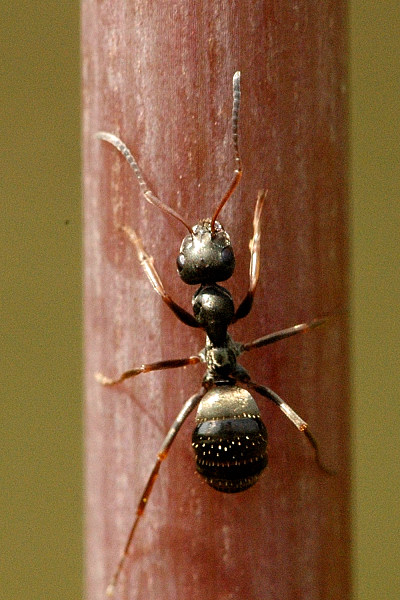
No matter how clean you keep your kitchen, ants will still sneak in. Initially, you might see just one or two ants, but if their source and route aren’t addressed in time, their numbers can rapidly increase and they may even begin to migrate to other parts of the house.
In this guide, we’ll show you easy and practical ways to prevent future ants in your kitchen, reduce your existing ant problem, and prevent them from returning.
Why do ants appear in the kitchen?
Kitchens provide ants with everything they need: food, water, and shelter. Even a spotlessly clean kitchen can attract ants if there are food crumbs between appliances, sticky residue on cabinets, moisture under the sink, or open entrances in plumbing.
The ants you see are foragers. If a forager ant finds food and returns to the nest, it leaves a trail of pheromones that attracts hundreds of additional worker ants.
Step 1: Identify what you have.
Image source: Wikimedia Commons
Knowing the species helps you choose the right bait. In the kitchen, you’re likely dealing with one of these:
-
Odorous House Ants—This is the most likely species. The most common, found in most homes, are small, dark brown-black ants that smell like rotten coconut when crushed. These ants prefer foods high in sugar.
-
Pharaoh ants—These are pale yellow and very small. They are often found inside walls or behind appliances. Do not spray them.
-
Argentine ants—Small, dark in color. They form large, interconnected colonies. They are very difficult to eliminate with sprays.
-
Ghost ants have a light, transparent body and a darker head. They are found primarily in the warmer southern states.
→ Complete Identification Guide
Step 2: Immediate Cleanup (Non-Toxic Primary Response)
-
Wipe down all surfaces with soapy water. Dishwashing soap destroys traces of pheromones (that ants use to communicate). Use it on counters, backsplashes, inside cabinet edges, and around the stove.
-
Locate and remove the source of food. Check for open sugar bottles, honey jars with sticky edges, crumbs behind drawers, or food spilled under appliances.
-
Store food in sealed containers. Rigid plastic or glass containers with tight-fitting lids are best. Ants can easily penetrate thin plastic bags, cardboard boxes, and loose containers.
-
Fix the source of moisture. Check for leaking pipes or damp wood under the sink. Ants are attracted to moisture, just like they are to food; they also love water.
Step 3: Apply the bait correctly.
Source: Wikimedia Commons
For kitchen ants, baits are much more effective than sprays because they directly target the root cause of the ant infestation, i.e., the entire colony and most importantly, the queen ant, and are much safer around food preparation areas.
What to use:
-
Liquid sugar-based bait stations (e.g., borax-based gel or liquid stations) work exceptionally well for odorous house ants, Argentine ants, ghost ants, and pharaoh ants.
Where to put them:
-
Along the ants’ path, including where they enter (baseboards, under the edge of the sink cabinet, near the base of the stove).
-
Not on the cooking countertop. Not under cabinets, at floor level, or behind appliances.
What not to do:
-
Avoid spraying contact insecticides near baiting areas or along trails where you plan to bait. This makes the bait less effective.
-
Do not crush the ants eating the bait; let them eat it so that they can take it to their nest.
Timeframe: Expect heavy activity near the bait for 3-7 days, then activity will rapidly decrease as the colony shrinks. Complete elimination may take one to three weeks.
Step 4: Seal entry points to the kitchen.
When the settlement begins to collapse, block future entry. To do this, you need to take a few important steps:
-
Seal where the pipes enter under the sink.
-
If there is a gap between the countertop and the wall near the backsplash, seal the gap.
-
Install a door sweep seal on the main kitchen door or any external doors located nearby.
What should not be used in the kitchen?
[Caution] Never spray general insecticide aerosols on food preparation surfaces, inside food storage cabinets, or near utensils. Even after drying, contact insecticide residues on food surfaces are a safety hazard.
If you need a contact spray for active, visible ants in the kitchen: You can easily make one using soap. A soapy water spray (a few drops of dish soap in water) is effective. Soapy water can be used to remove visible ants and clean up their trails. Wipe food-contact surfaces with clean water afterward.
Preventing ants in the kitchen long-term
-
Daily: Clean counters and stovetops. Prevent the formation of scent trails or pheromones.
-
Weekly: Check under appliances and at the bottom of cabinets for fallen crumbs.
-
Seasonal: Check exterior foundation and kitchen entry points (plumbing pipes) and reseal as needed.
→ The Complete Guide to Ant Prevention
If you have any experience of getting rid of insects from the kitchen, please share it with us.
Sources & References
- EPA — Integrated Pest Management in School Kitchens